
SpeechGeek Presents: Female/Female Duos, Vol. 3
Download a preview of this issue.
Purchase this issue in the SpeechGeek Online Store.
Quality forensics performance material is often difficult to find. SpeechGeek provides high school coaches and competitors with scripts that are not only challenging, but also of strong literary merit. Each issue of SpeechGeek contains five scripts in a variety of events: prose interpretation, poetry interpretation, humorous interpretation, dramatic interpretation, and duo interpretation. SpeechGeek’s interp scripts are written by winning authors who know what it takes to make final rounds at all levels of competition.
Go On, Girl! by Rebecca Spero
Duo Interpretation (Female/Female)
Carolyn and Jill have had enough. After years of serving as dutiful housewives, they decide to pack up, empty their savings accounts, and pursue their dreams. Inspired by their experiences, they create a stage show called “Go On, Girl!” Things start out great but quickly turn sour as they trade one brand of relationship abuse for another.
Tips by Julia Neva
Duo Interpretation (Female/Female)
One of the most thankless jobs on earth is to serve as a waiter or waitress at a chain restaurant. On her first day at work, Susan meets a variety of the worst customers imaginable. The good news is that she also meets a person who knows what it’s like to be in her shoes. Fast-paced with plenty of room for physicality, this is a great starter piece for a new performer.
Somewhere in Between by Meredith Allen
Duo Interpretation (Female/Female)
Stacy’s priorities are completely out of whack. Though she is a high-power attorney, Stacy has forgotten about the most important woman in her world: her month. When a bus accident sends her into the great beyond, God walks Stacy through her missteps and gives her the opportunity to make things right…before it’s too late for herself or her mom.
Room to Wait by Rebecca Spero
Duo Interpretation (Female/Female)
Cathy and Samantha have the kind of step-mother/daughter relationship reminiscent of classic fairytales. (Hint: it’s not very good.) While in a hospital waiting room to learn the fate of the man who connects them, they realize that life-changing experiences bring the opportunity to set things right.
The Sisters Smith by Laura Morris
Duo Interpretation (Female/Female)
Step-sisters Taylor and Annie started out as best friends. As they each became teenagers, jealous and spite tore them apart. A tragic accident brings them back together and forces Taylor to imagine what a world would be like in which they stayed as close as they once were.
As part of the holiday season, we’re proud to share with the first 15 customers who make a request a copy of our first issue of interp scripts tailored for middle school students and teams. These scripts originally appeared in early editions of SpeechGeek. Please complete the form to receive your printed copy.
Update 12/08/10: All complimentary copies have been claimed. We encourage you to LIKE SpeechGeek on Facebook to learn about special offers such as this, customer discounts, and other forensics news.

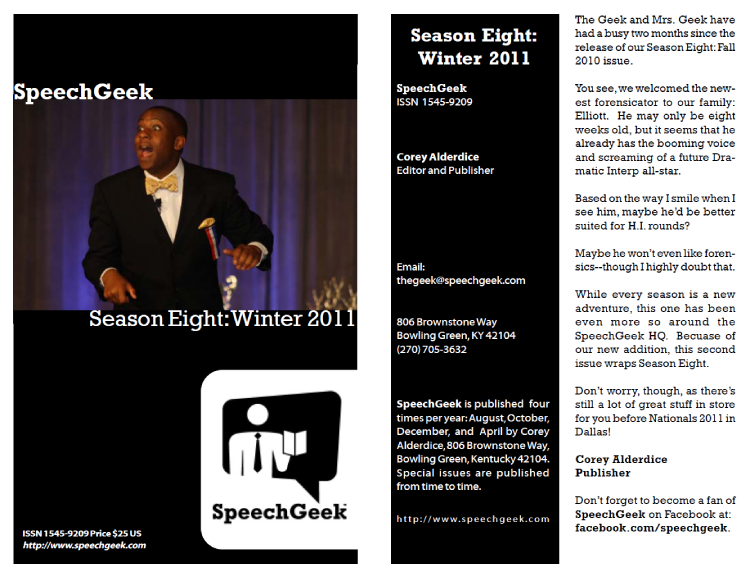
Our latest issue of interp scripts is now available!
SpeechGeek Season Eight: Winter 2011
Quality forensics performance material is often difficult to find. SpeechGeek provides high school coaches and competitors with scripts that are not only challenging, but also of strong literary merit. Each issue of SpeechGeek contains five scripts in a variety of events: prose interpretation, poetry interpretation, humorous interpretation, dramatic interpretation, and duo interpretation. SpeechGeek’s interp scripts are written by winning authors who know what it takes to make final rounds at all levels of competition.
Hypothetically Yours by Katie Newport Duo Interpretation (Male/Male)
Brian comes to his best friend Jeremy for advice about the best way to propose to his longtime girlfriend. The two work through a variety of hypothetical situations in which the proposal could go right…but they each go horribly wrong. There’s lot of room for physicality and humor in this introductory offering from Katie Newport.
Chasing Snowflakes by Katie Newport Duo Interpretation (Male/Female)
A snowy evening force Michael and Anna, two young people in love, to reflect on their first date. It turns out that their relationship almost never happened. Through a series of misunderstandings, Michael begins to wonder why they are even still together. A snowy evening brought them together, but it may bring an end to their love, too.
How to Do Nothing Successfully by Clint Snyder Humorous Interpretation
Mall-Mart’s all-start team leader Ricky introduces a new crop of employees to the practices that ensure Mall-Mart employees are top notch. It’s too bad that Ricky is an undercover spy for Jay Mart.
For My Baby by Beatrice Pickens Dramatic Interpretation
Picken’s short duet follows a young couple through various stages in their life and relationship. Stopping in at ages eight, sixteen, and twenty-five, the story explores the growth of their twisted relationship from infatuation, to control, to new life, and death.
Reggie Wilson: Boy Detective by Christopher Rife Humorous Interpretation
Reggie Wilson is Apple Valley’s greatest boy detective. Reggie’s only problem is that he doesn’t have a clue. A wild cast of characters follow Reggie as he attempts to determine if their teacher is a robot! (Hint: He is!) Goofs and gags are aplenty an HI that is sure to please audiences.

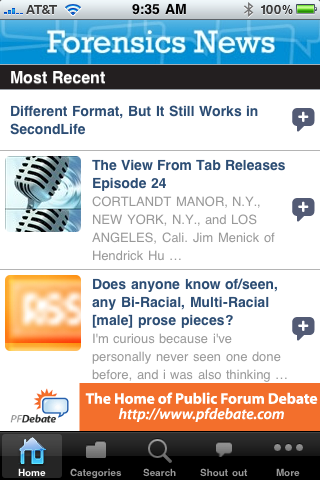 With the wealth of speech and debate websites available, it’s often hard to keep up-to-date on all the latest news, results, and commentary. SpeechGeek is excited to share the 4n6 app for mobile phones! The app is a free download available in the Apple iTunes App Store and Google Android Market.
Combining news and social content from the most popular forensics websites, 4n6 is the one-stop resource for high school speech and debate. News, tweets, and other social content is just a tap away. We are proud to partner with websites such as PFDebate, Victory Briefs Daily, Global Debate, The National Forensic League, Extemp Central, Forensics Community, The Forensics Posting Weekly, and RupeScholars.org to provide you with a tool for easy access to the best forensics content online.
We encourage users who also tweet to use the #4n6 hashtag in forensics-related tweets. This helps to build a community of users and participants in the forensics discussion.
From your first prep to the final round at Nationals, 4n6 is the app for the true Speech Geek!
Keep reading to check out some screenshots of the app.

Purchase this issue in the SpeechGeek Store.
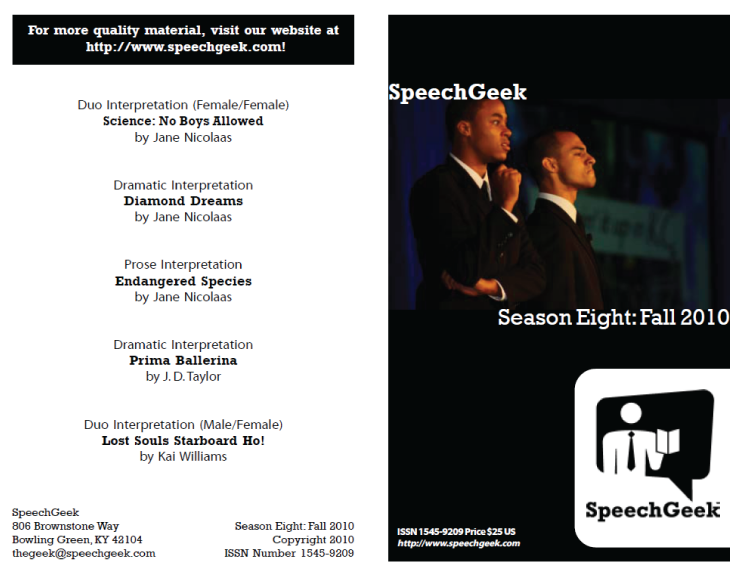
Season Eight: Fall 201Purchase this issue in the SpeechGeek Store.
SpeechGeek Season Eight: Fall 2010
Quality forensics performance material is often difficult to find. SpeechGeek provides high school coaches and competitors with scripts that are not only challenging, but also of strong literary merit. Each issue of SpeechGeek contains five scripts in a variety of events: prose interpretation, poetry interpretation, humorous interpretation, dramatic interpretation, and duo interpretation. SpeechGeek’s interp scripts are written by winning authors who know what it takes to make final rounds at all levels of competition.
Science: No Boys Allowed by Jane Nicolaas Duo Interpretation (Female/Female)
Two sisters are on a quest to win the school science fair in this wacky comedy debut by Jane Nicolaas. Precocious youngster Ina takes her annoying younger sister Angelica along for the ride as the two explore the male of the species. Can they create the perfect boy?
Diamond Dreams by Jane Nicolaas Dramatic Interpretation
Miguel Santana is a young Dominican man who dreams of something more in life. His world is filled with poverty, yet his hopes are pinned on the one thing he knows he can do: throw a baseball. When an American agent comes into his life, Miguel may have finally found an avenue to save his family and provide them with a better life. Mr. Jack, though, sees only a better life for himself—and his bank account—in Miguel’s talent. A story of dreams and aspirations that is sure to wow audiences.
Endangered Species by Jane Nicolaas Prose Interpretation
A college student accompanies his girlfriend to a doctor’s visit he wish he didn’t have to attend. Despite being in love, they are not ready to see through an unplanned pregnancy. It’s an uncomfortable situation to say the least: “The woman stares at me. I guess that’s the wrong thing to do? I don’t know. I guess I forgot my abortion etiquette handbook: What to Expect When You’re about to Stop Expecting.” In a room of women who expect him to be the bad guy, he demonstrates that timing is everything and nothing at all.
Prima Ballerina by J.D. Taylor Dramatic Interpretation
Athena Pallas may now be an old, bitter dance instructor, but she was once one of Europe’s most gifted ballerinas. As the Hitler’s reach extends across Europe, the young dancer rises to stardom. When they are invited by Hitler himself for a performance, she is faced with an amazing opportunity and a terrible decision. She learns that fear is a powerful motivator and inaction can lead to a lifetime of regret.
Lost Souls Starboard Ho! Duo Interpretation (Male/Female)
Shawn and Lynn have suffered the loss of their daughter. In this emotional drama, the couple must come to terms with their loss while bridging the growing distance in their relationship. Will this crisis cause even more loss, or will they find a way to move on and love again?

 It’s been a busy year on the college speech circuit. Congratulations go out to Bradley University on winning the 2010 American Forensic Association‘s National Individual Events Tournament (AFA-NIET).
Next week marks Round 2 for the college speech and debate competitors as the National Forensic Association Championship takes place on the campus of Ohio University. SpeechGeek will be there live from the first ballot to the final sweepstakes trophy. Last year, we provided Twitter updates throughout the tournament. This year marks the start of something bigger.
Our coverage will include daily feature posts, photo albums, video blogs, Q&A pieces, and more. Once outrounds begin, we’ll have photos from postings and updates as the tournament progresses. If you can’t be in Athens, SpeechGeek Postings is the place to be! You can follow the updates on our site on Facebook and Twitter. If you are using Twitter, we encourage you to include an #NFA or #NFA10 hashtag in your tweets.
Our coverage will culminate in a Cover It Live page on our main site with a trophy-by-trophy breakdown at the awards ceremony on Monday night.
There’s lots of fun ahead. We hope you’ll join us next week at the SpeechGeek Postings blog.

Season Seven: Nationals 2010
SpeechGeek Season Seven: Nationals 2010
Purchase it in our online store!
Quality forensics performance material is often difficult to find. SpeechGeek provides high school coaches and competitors with scripts that are not only challenging, but also of strong literary merit. Each issue of SpeechGeek contains five scripts in a variety of events: prose interpretation, poetry interpretation, humorous interpretation, dramatic interpretation, and duo interpretation. SpeechGeek’s interp scripts are written by winning authors who know what it takes to make final rounds at all levels of competition.
Senseless by Katherine Raul Dramatic Interpretation
Ellie, a middle-aged woman who has been deaf most of her life, begins the selection with a smile. “Some people think it’s ridiculous, a deaf woman with an iPhone. But that’s just ignorance, and there’s no app for that,” she explains. A selection that offers the performer an exceptional vocal challenge and additional physical skill by learning American Sign Language to boot, Senseless is the perfect piece for a seasoned performer looking to take things to the next level.
Pinnochia by Natalie Pronk Humorous Interpretation
Being a teenager is hard. When you’re a papier-mâché puppet made from fashion magazines, well, it’s even more difficult. Natalie Pronk returns to SpeechGeek with an outstanding humorous interp script for female performers. Mean Girls meets a fairy tale classic that is sure to wow audiences.
God in a Grilled Cheese Sandwich by Clint Snyder Dramatic Interpretation
Alex is a teen that has lost sight of the meaning in life and makes a plan to commit suicide, but at the last second Alex is saved by the idea that he is not the only one looking for something more, an idea that presents itself in the form of a grilled cheese sandwich. A charming contribution from newcomer Clint Snyder.
On My Own Two Feet by Clint Snyder Duo Interpretation (Female/Female)
Two sisters try to make sense of what has become of their family is this outstanding duo for two female performers. Jane is strong-willed and tough. She uses jokes or anger as a defense mechanism to cover up her pain over her parents’ divorce. Caryn is a sensitive girl with pale features and a genuine curiosity about the world. She tries to find the good in everything and everyone. These confliction personalities are the perfect matchup for an exploration into loss and finding oneself anew.
Psychobabble Cliché Blues by Clint Snyder Duo Interpretation
Charlotte, a dignified businesswoman, goes to see a psychologist because of her life-long fear of clowns. The free spirited psychologist, Michelle, agitates Charlotte with her string of cliché psychobabble and ends up revealing that she may be in need of some therapy herself.
Because there’s no place like FIRST for the holidays!
ENTER CODE “NOPLACELIKE” TO TAKE ADVANTAGE OF THIS SPECIAL OFFER.
As one who enjoys hearing from SpeechGeek from time to time, we’re happy to share with you a 51% discount on all orders greater than $20 on Friday, December 18, 2009. In these times of budgetary restrictions, we’re here to help. We also want to say thank you for helping to make 2009 our best year ever.
To view our full newsletter, visit: http://speechgeek.com/newsletter/200912.html.

Season Seven: Spring 2010
Quality forensics performance material is often difficult to find. SpeechGeek provides high school coaches and competitors with scripts that are not only challenging, but also of strong literary merit. Each issue of SpeechGeek contains five scripts in a variety of events: prose interpretation, poetry interpretation, humorous interpretation, dramatic interpretation, and duo interpretation. SpeechGeek’s interp scripts are written by winning authors who know what it takes to make final rounds at all levels of competition.
The Genetically Altered Book of Genesis by Connor McElroy
Humorous Interpretation
It’s been a busy week for the Lord. After creating the heavens and the earth, he moves on to his greatest project yet…man. The debut selection from Connor McElroy reexamines the creation story with a not-so-bright Adam, a sssssslithering serpent, and other wacky characters. A great selection for students who enjoy performing teched out pieces!
The Relationship by Doug McConnaha
Dramatic Interpretation (Male/Female)
McConnaha follows a couple through several stages of their lives together. The story begins on the playground and progresses as the two young lovers become married adults. With winks and nods to the audience, John and Nikki pass along the laughs and the frustrations of sharing your life with another person.
Ants by Clint Snyder
Dramatic Interpretation
A young summer camp counselor knows what it’s like to feel insecure and need to please other people. Sam can see these traits in Clark, almost as a reflection, and hopes to find some peace by solving Clark’s own problems because he is still too insecure to face his own. Snyder presents a monologue that shows that no choices are easy, especially when they are life changing. Is it better to step forward to save a life, or is it any of our business?
The Art of Theater by Doug McConnaha
Duo Interpretation
An acting class turns bizarre in this selection from Doug McConnaha. The artistic director of a private school reaches out to his students, and they reach back with enthusiasm. It’s only too bad they’re all terrible actors. This duo will provide both actors with room to perform and stretch their abilities.
The Conversation Zone by Doug McConnaha
Humorous Interpretation
Have you ever been caught in a conversation that never ends? A conversation that goes on and on and says nothing? Why do people have the need to tell you all the personal and intimate details of their lives? We’re about to meet several people who all have “stories.” Imagine yourself sitting on a plane, standing in a line, or trapped in a room with one of these people. Welcome to: The Conversation Zone.


SGP: F/F Duo, Vol. 2
Quality forensics performance material is often difficult to find. SpeechGeek provides high school coaches and competitors with scripts that are not only challenging, but also of strong literary merit. Each issue of SpeechGeek contains five scripts in a variety of events: prose interpretation, poetry interpretation, humorous interpretation, dramatic interpretation, and duo interpretation. SpeechGeek’s interp scripts are written by winning authors who know what it takes to make final rounds at all levels of competition.
This special issues covers the script request that we receive most often: duos for two female competitors. This mix of humorous and dramatic scripts is sure to wow audiences.
Enter our online store to purchase this issue.
A Brief Primer on the Female of the Species by Julia Neva
Duo Interpretation
A professor and her graduate student walk the audience through the high and low moments in the history of the female of the human species. Marvel at the first time in history when a man stole a woman’s great idea. See Joan of Arc outwit the French military leadership…and get burned at the stake! Finally, follow the Suffragettes as they fight for equality among genders—a fight that remains ongoing today. Neva’s blend of outright humor and commentary will provide students with a wide-ranging performance that is sure to please audiences.
Lessons in Throwing Your Voice by Julia Neva
Duo Interpretation
Emily is surrounded by dummies. Emily’s pregnant mother can’t seem to get it through her head that Emily isn’t coping well with their new situation. Count Dork-ula, her mother’s new boyfriend, is as nerdy and absent-minded as they come. A kind gesture goes awry when Emily is given a ventriloquist’s doll as a gift. Sassy Sally is more than a hunk of wood. The fake doll keeps it real with Emily about her mom’s divorce, her new sibling that’s on the way, and the other gripes at the front of her mind. This duo brings tremendous potential for a tech-stravaganza for two talented performers!
Swerve by Amanda Thompson
Duo Interpretation
Callie lost her boyfriend of three years in an automobile accident. Though she pretends all is well, her friends and family are worried that all is not as it seems. Emma, her best friend, is charged with the task of getting Callie to talk about the traumatic experience. Thompson serves a drama of trust and friends, of moving on when there’s no other choice.
Thirty-Six Minutes by Jesse Gall
Duo Interpretation
When their mother must finally move into an assisted care facility, two sisters sort through the remnants of their mother’s possessions. What remains is more than simple possessions. Tremendous resentment over life choices—the decision to stay or go—forces Kate and Deb to confront the decisions they have to make and those that were made long ago.
The New Girl by Julia Neva
Duo Interpretation
Kimmy Kilgore was one of the country’s top young TV celebrities. After the cancellation of her show, she suffered a fate worse than death: being sent to public school. On her first day as “the new girl” she meets Sarah, who is also new to the school. Though they come from different worlds, the two girls help each other realize that no matter how great our differences are, the commonalities we share mean we are never alone.
Enter the Store

 SpeechGeek Market Blog
- GUEST POST: How to Keep an Over-Practiced Piece Fresh June 28, 2016
- GUEST POST: Foils in Duo June 28, 2016
- GUEST POST: How to Avoid Vague Gestures in Interp June 28, 2016
- "What Do You Mean By, 'Debate Like a Girl?'" July 3, 2014
- "Debate Like a Girl" T-Shirt Fundraising Progress July 2, 2014